

What “Premium Coffee” Actually Looks Like Before It’s Sold to You
April 21, 2026 · 6 min read
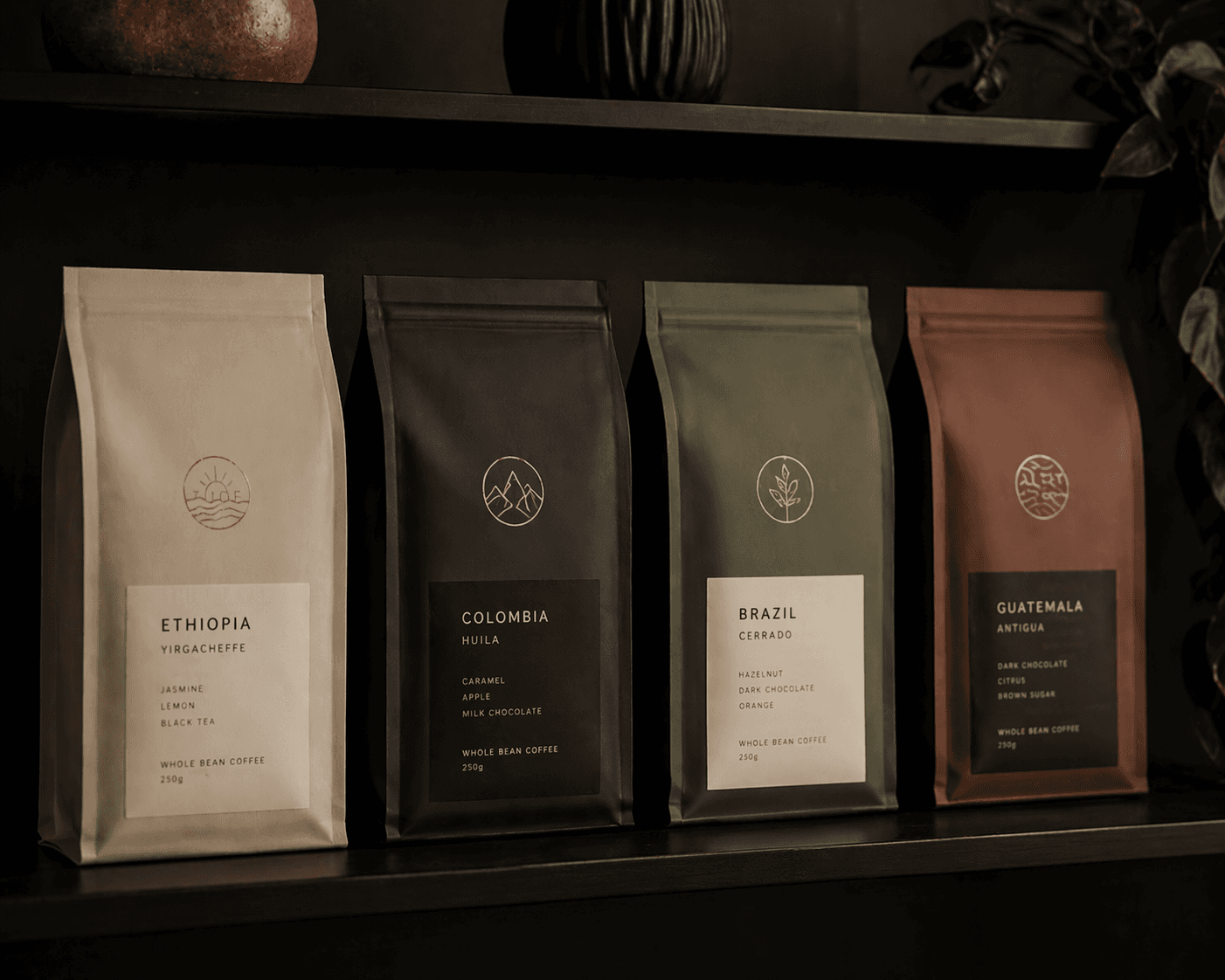
Premium coffee usually starts working before you ever brew it.
Matte bag. Clean type. A farm name that feels important. Tasting notes that sound like dessert (Toasted Marshmallow? Sign me up). Before you even open it, you already expect it to be good.
Premium Has Layers
There’s the version you see _before_ the brew: packaging, language, story, and price. That whole layer shapes how you feel about the coffee before you taste it.
Then there’s the part that actually shows up in the cup: the quality of the green coffee, how it was processed, and how it was roasted.
Good coffee lines those up.
The Package Talks
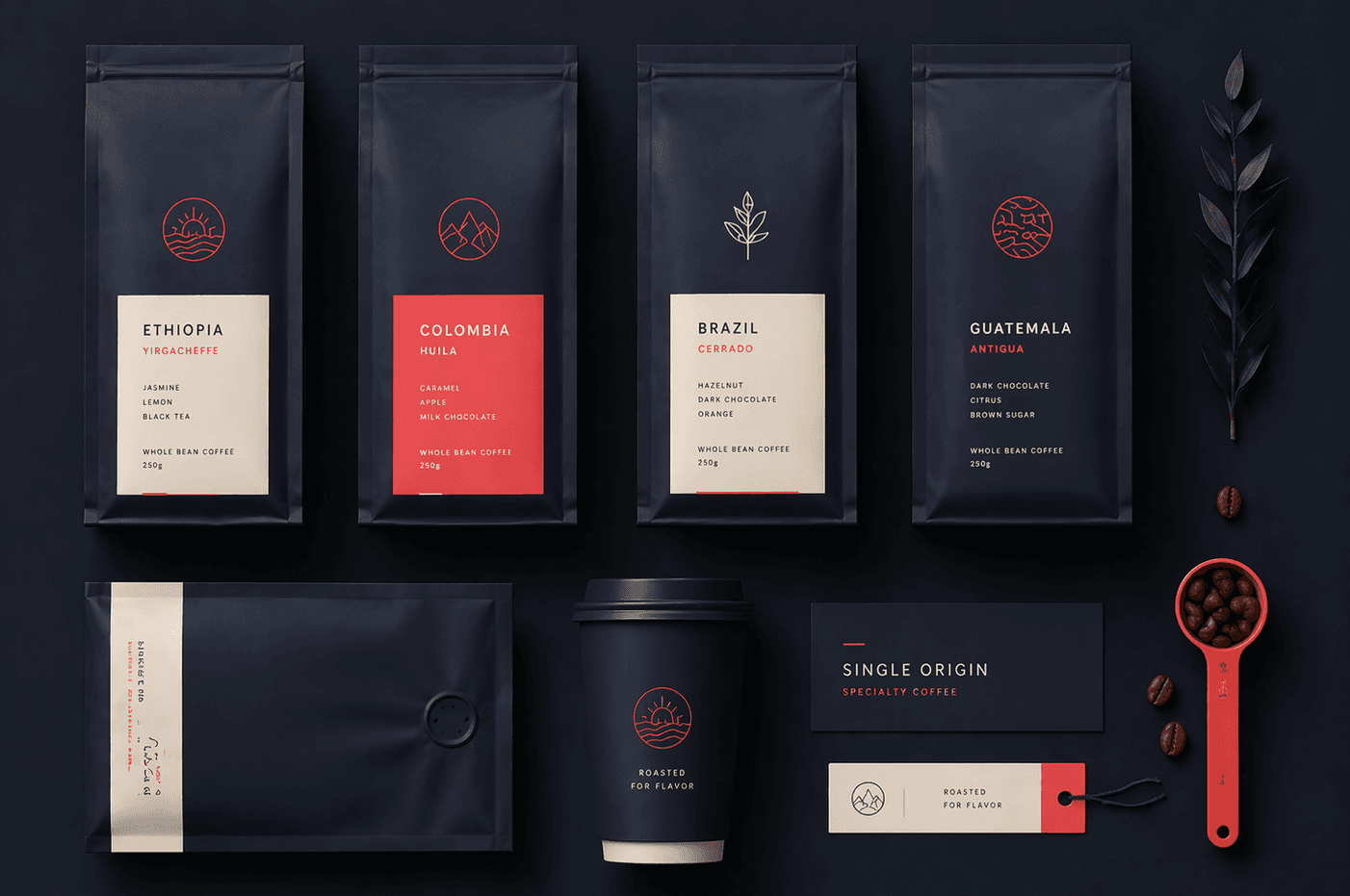
Packaging isn’t just for show. It’s direction. Something to catch your eye or push you to feel a way.
Light, bright colors tend to push expectations toward sweetness and fruit, while darker tones lean toward heavier, chocolate-forward profiles. There are no objective truths here. But every font choice, color, shape, texture... all play a factor. Clean, minimal design often reads as “high-end,” whether it earns it or not.
Same coffee. Different bags? Different expectations. Once an expectation is set, it’s hard to undo.
Premium Looks Different Now
For a while, premium coffee had a very specific aesthetic: minimal, neutral, restrained. That version still exists, and it still works very well.
But it’s no longer the only signal.
The newer wave can be louder, but still controlled. Bold design. Cohesive systems. Casual voice with consistent execution. Premium, nonetheless.
Premium used to signal itself by being quiet and restrained.
Now it can signal itself by being distinct and well-executed.
Minimalism still works. Showing some (or a lot) of personality works too! Especially if it’s done with precision.
Scarcity Changes How You Think
“Limited release.” “Micro-lot.” “Only a few bags.”
Now you’re not comparing. You’re reacting.
A $38 bag feels expensive. Butttt... what if I told you it came from a single farm, a rare variety, processed with extra steps most coffee never sees, and produced in a batch small enough to disappear in a week? Don't get me wrong, $38 might still feel hefty. But at the very least, it feels justified.
And each part of that matters, but not in the same way.
- A single farm means consistency and traceability. You’re not getting a blend of dozens of sources averaged together. You’re getting something specific, shaped by one place, one set of conditions, one set of decisions. That usually means more control.
- A rare variety (like Geisha) changes the ceiling as well. Some coffee varieties just have more potential for complexity or sweetness, but they’re harder to grow, lower yielding, and riskier for farmers. Those factors drive the cost up.
- Processing is where things can swing the most. Extra steps, like extended fermentation or controlled drying, can push flavor in a very intentional direction. Done well, it creates clarity and distinct character. The premium comes from the skill and attention required to get it right.
- And then there’s the batch size. Small lots aren’t just a marketing angle. They’re often a byproduct of everything else. Limited yield, careful selection, higher standards (and higher prices). You can’t scale that easily, which is why it disappears quickly.
None of those things guarantee the coffee will be great. But they do explain why it might be priced differently.
And once you see it that way, it stops being just a $38 bag. It becomes a set of decisions, constraints, and effort that led to that number.
Which leads to something that matters just as much as quality: clarity.
It’s 2026. People have access to more information (and AI) than ever. If someone wants to understand something, they can. And in most cases, they will. So if a bag costs more, the question shouldn’t feel like a guessing game.
“Why does this cost so much?”
That shouldn’t require a deep-dive. It should be obvious, or at least easy to understand. Because when it’s not, people default to one conclusion: it’s probably just marketing. And sometimes… they’re right.
Transparency
From a brand’s perspective, transparency isn’t about saying everything. It’s about saying the right things, clearly.
Where the coffee came from. How it was processed. What actually makes it different.
Not in a way that tries to impress, but in a way that helps someone understand what they’re buying.
When the work is real, you don’t need to hide behind hand-wavy language or juiced-up descriptions. If there's no explanation for why something costs more without stretching the story, that’s usually a signal.
Not every customer needs every detail. But the details should be accessible for the ones who care.
That’s what builds trust.
And in a space where “premium” can be crafted pretty easily, trust ends up being the real differentiator.
Where Premium Is Actually Earned
Real premium shows up upstream.
Better green coffee costs more. Certain processes give more control, some carry more risk. But there’s another piece that matters just as much: time.
Speaking of time, Jay-Z owns a one-of-one Richard Mille watch that reportedly took around 3,000 hours to make. That’s more time than it takes to build an entire house (or several)! But no one sees those hours when they look at the watch. They just see the result.
Coffee works the same way.
- Sorting through beans and pulling defects by hand
- Running multiple roast passes to find the perfect flavor profile
- Adjusting, tasting, (again, and again, and again, and again... then again 🥵) and sometimes discarding batches that miss the mark
None of that shows up on the label. There’s no badge for “spent an extra hour cleaning up defects” or “scrapped three batches to get this right.” But when you know what to look for...
It’s right there. Next time you open a bag of beans, note the consistency—uniform color, intact beans, nothing that looks out of place. Then, you taste it as clarity. Something that just feels dialed in.
The Roast
You can do everything else right and still lose here.
Roasting is where sweetness shows up or disappears. Where acidity feels clean or harsh. Where all the upstream work either gets expressed or flattened (even ruined).
You can’t package your way out of a bad roast. It still has to taste good. I mean... that's why we're here right?
The Only Question That Matters
When something looks premium, the question isn’t “is this marketing?”
Because it definitely is.
The better question is whether the marketing points to something real: whether the work is actually there, or whether the presentation is doing most of the lifting.
We all like nice things. Here at Laserjuice, we’re not trying to remove the first layer. Design matters. Presentation matters. That initial vibe matters. BUT, it has to line up to what's actually in the cup.
Because time, effort, and attention don’t always look impressive. They just taste better.
Share this with someone who's picky about coffee →